

 Türkçe
What is a Shock Absorbing Lanyard and How Does It Work?
A lanyard with a shock absorbing system is a technical piece of equipment that connects the personnel’s safety harness to secure anchorage points at high elevations. Its primary duty is to arrest falls or to restrain workers by preventing them from reaching dangerous edges. While this equipment is generally manufactured from static ropes produced in accordance with the EN 1891 standard, it can also be manufactured from webbing, steel wire rope, or chain materials depending on the application area.
Anatomy and Components of a Shock Absorbing Lanyard
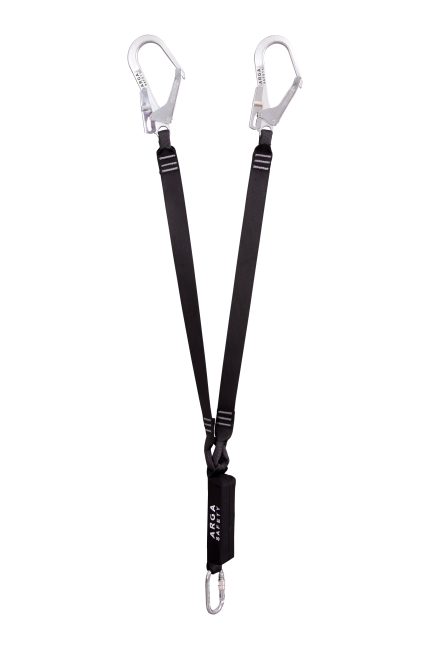
The shock absorbing unit on the lanyard consists of a stitched webbing technology, usually enclosed in a special protective pack. This mechanism operates through the integration of the following components:
-
Energy Absorbing Unit: Elastic fibers or special stitching within the pack absorb energy during a fall.
-
Connecting Connectors: Establish a secure bridge between the safety harness and the anchorage point using carabiners or scaffold hooks.
- Carrier Body: The main line in rope or webbing structure.
Working Principles of Shock Absorbing Technology
The working principle of shock absorbing systems is based on the controlled dissipation of physical kinetic energy. When a fall occurs, the system follows these stages:
-
Energy Absorption: The special stitching in the internal structure begins to tear at a specific load threshold (approximately 2 kN). This controlled tearing softens the shock at the moment the fall is arrested and dissipates the energy by converting it into heat.
-
Load Distribution During Fall: The design of the lanyard distributes sudden loads across the user’s body to prevent internal organ and spinal injuries. While the impact directly hits the body on conventional ropes, the shock absorber keeps this impact under control.
-
Stopping Distance Control: The length of the lanyard extends when the shock absorber deploys. This controlled extension prevents the personnel from stopping abruptly and swinging violently. At this point, “Clearance Distance” calculation is of vital importance.
Legal Standards and Technical Certification
Shock absorbing lanyards must be manufactured in accordance with the Occupational Health and Safety Law No. 6331 and the Personal Protective Equipment Regulation. The standards taken as basis in this process are as follows:
-
EN 355: Determines the testing and certification criteria for energy absorbers against falls from height.
-
EN 365: Covers instructions for use, marking, and periodic inspection specifications.
-
RfU11.074 EC: Certification for suitability in horizontal use and sharp edge protection. This additional certification must definitely be sought in areas with a sharp edge risk.
On a global scale, standards such as ANSI/OSHA (USA), CSA (Canada), and Gost R (Russia) also verify the safety of this equipment.
Differences Between Shock Absorbing Lanyards and Conventional Lanyards
The difference between using a shock absorber and a conventional (fixed) lanyard can draw the line between life and death in an accident:
| Feature | Conventional Lanyard | Shock Absorbing Lanyard |
| Energy Dissipation | None (transmits the impact force directly) | Available (absorbs and dissipates kinetic energy) |
| Maximum Impact Force | 12-18 kN (risk of fatal damage) | Below 6 kN (OHS and medical limit) |
| Injury Protection | Risk of bone fracture and spinal damage is high | Minimizes the risk of injury |
| Anchorage Stress | Places excessive load on the anchorage point | Softens the load on the anchorage |
| Legal Status | Suitable only for positioning | Mandatory for fall arrest |
Sectoral Usage Areas and Application Fields
Shock absorbing systems find their place with different designs in every sector where working at height is involved:
-
Construction and Building Sector: Used against fall risks in roofing works, facade scaffolding operations, and steel construction installations.
-
Energy and Telecommunications: In areas with intensive vertical mobility such as wind turbines, solar plants, and base station towers.
-
Mobile Horizontal Lifelines: The heart of the system in temporary working lines (steel lines 4-30m, textile lines 4-20m).
-
Industrial Climbing and Rope Access: Provides safety in rope access operations and high load-bearing systems.
-
Maritime and Offshore: Models with corrosion-resistant (stainless steel components) are preferred in vessel maintenance and offshore platforms.
-
Leisure and Adventure: Ensures visitor safety in adventure courses and zip-line runs.
Field Analysis, Maintenance, and Tips for Use
Technical measures must be taken completely for shock absorbing lanyards to work effectively:
-
Clearance Distance Calculation: The safe stopping distance must be calculated by adding: Lanyard length + Shock absorber deployment length + Height of worker + Safety margin (generally 1 meter).
-
Environmental Conditions: Equipment integrity must be checked in environments with extreme heat and cold, or chemical contact.
-
Periodic Inspection (EN 365): Must be inspected by an authorized expert at least once a year in accordance with manufacturer instructions.
-
Single-Use Structure: Once a shock absorber arrests a fall (the pack is deployed), its duty is considered complete; it must be destroyed immediately and replaced with a new one.
As ARGA SAFETY, we determine the most appropriate equipment configurations by performing area-specific field analysis for your working zones. We minimize your working at height risks with professional occupational safety solutions and periodic inspection services.